Fear Not 220
Posted Friday, May 15, 2026 at 06:17 AM
Verse #124 of 220
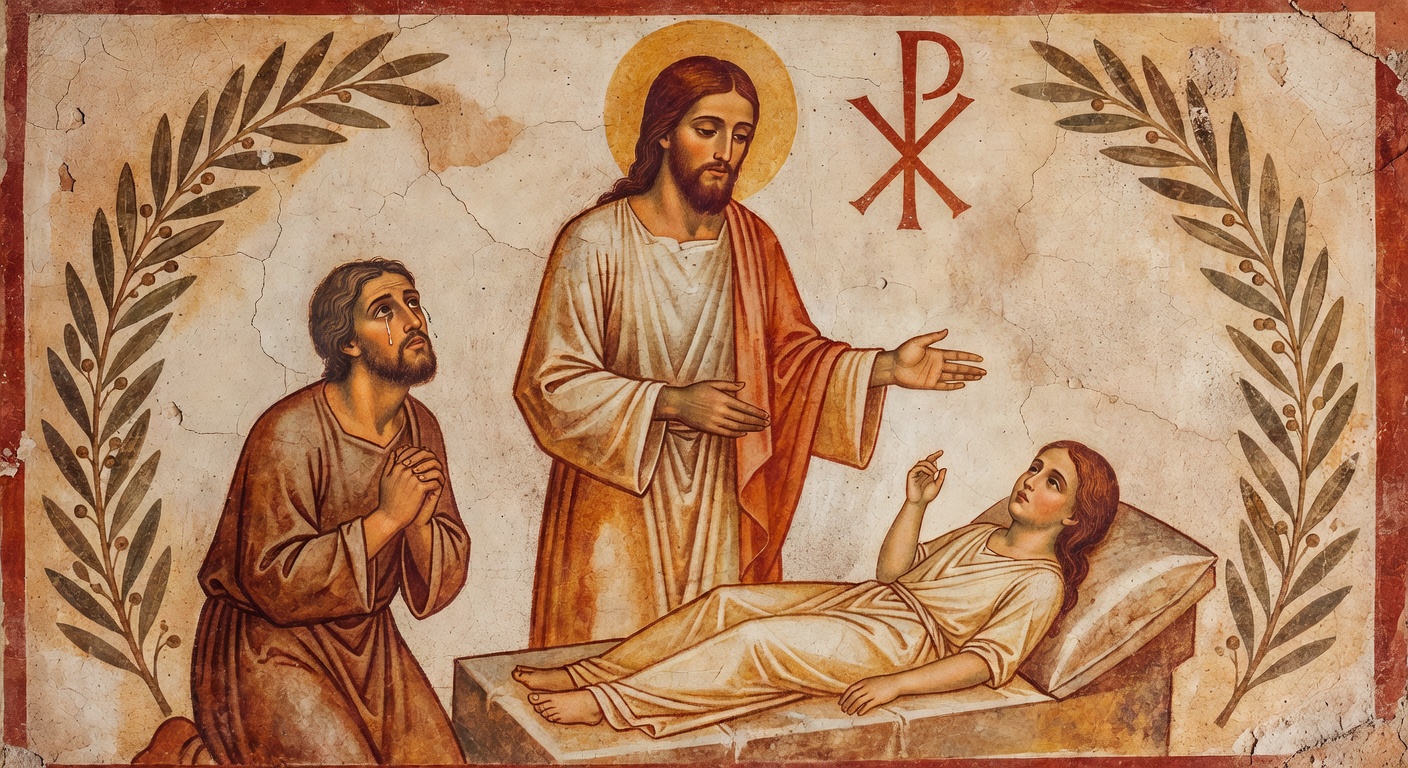
Brethren in Christ, gathered beneath the shadow of the cross in these turbulent times of emperors and persecutions, let us turn our hearts to the words of our Lord as recorded by the blessed Evangelist Luke: 'Do not be afraid; just have faith...' (Luke 8:50). These words, spoken to Jairus, the ruler of the synagogue, pierce the veil of our mortal fears like the dawn breaking through the darkest night.
Consider the context, my dear ones, drawn from the sacred annals of Scripture. Jairus, a man of stature among the Jews, falls at the feet of Jesus, beseeching Him to heal his only daughter, twelve years of age, who lies at the point of death. As they journey, the crowds press upon the Master, and amidst this tumult, a woman afflicted with an issue of blood for twelve years touches the hem of His garment and is healed by her faith. But lo, messengers arrive with tidings of despair: 'Thy daughter is dead; trouble not the Master.' It is here, in this moment of utter desolation, that Jesus turns to Jairus and utters these immortal words: 'Fear not; believe only, and she shall be made whole.'
Oh, how the Early Fathers of our Holy Church have illumined this passage! The great Origen, that profound interpreter of the mysteries, teaches us in his commentaries that Jairus represents the synagogue of old, seeking life for its daughter—the people of Israel—through the coming of the Messiah. Yet, interrupted by the woman with the flow of blood, whom Origen sees as the Church of the Gentiles, flowing with the blood of martyrdom and healed by touching Christ in faith. Thus, the raising of Jairus' daughter signifies the resurrection of the ancient people through belief, even after apparent death.
Saint Ambrose, the eloquent bishop of Milan, expounds in his treatise on Luke that fear is the enemy of faith, for 'fear hath torment,' as the Apostle John declares. Ambrose urges us to cast aside the fears born of this world's tempests—be they the persecutions under Diocletian or the heresies of Arius—for faith in Christ revives the soul as He revived the maiden. 'She was not dead,' Ambrose notes, 'but sleeping,' echoing the Lord's words, to show that death itself is but a slumber to those who believe.
From the Catena Aurea, that golden chain compiled by the Angelic Doctor Thomas, we glean the wisdom of Chrysostom, the golden-mouthed. He observes that Jesus dismisses the flute-players and the wailing crowd, for faith requires silence and solitude, not the clamor of unbelief. 'Arise,' He commands the girl, and she rises, eats, and walks—a figure of the soul awakened from sin's death, nourished by the Eucharist, and walking in the ways of righteousness.
The venerable Bede, too, in his homilies, draws a parallel to our own lives in these early centuries. Just as Jairus must ignore the messengers of doom—those voices of doubt and pagan philosophy—so must we, amidst the idols of Rome and the threats of martyrdom, cling to faith alone. For what is faith but the substance of things hoped for, the evidence of things not seen, as the Epistle to the Hebrews proclaims?
Beloved, in the ancient world of Judea, under Roman yoke, this miracle unfolded not as mere history, but as eternal truth. The daughter's age of twelve evokes the twelve patriarchs, the twelve apostles—signifying the fullness of God's people revived. The woman's twelve years of affliction mirror this, showing that faith heals the chronic wounds of sin, whether in Jew or Gentile.
Let us, then, emulate the Fathers: Cyril of Alexandria warns against the laughter of the crowd, which mocked Jesus' claim that the girl slept. Such is the world's scorn for our hope in resurrection. Yet Christ enters the house of death—our mortal bodies—and with Peter, James, and John (faith, hope, and charity, as Augustine interprets), He raises us up.
In this homily, I beseech you: When fears assail like lions in the arena, remember Jairus. When death seems final, recall the maiden's rising. Faith is not passive; it is the active trust that moves mountains, calms seas, and conquers empires. As Gregory the Great teaches, faith is perfected in works, seen in Jairus' plea and the woman's touch.
Thus, brethren, do not be afraid; just have faith. For in Christ, death is defeated, fear is banished, and life eternal awaits. Amen.
#FearNot220 #FearNotUNPLUGGED #124of220 #Catholic