Fear Not 220
Posted Friday, May 08, 2026 at 03:17 PM
Verse #091 of 220
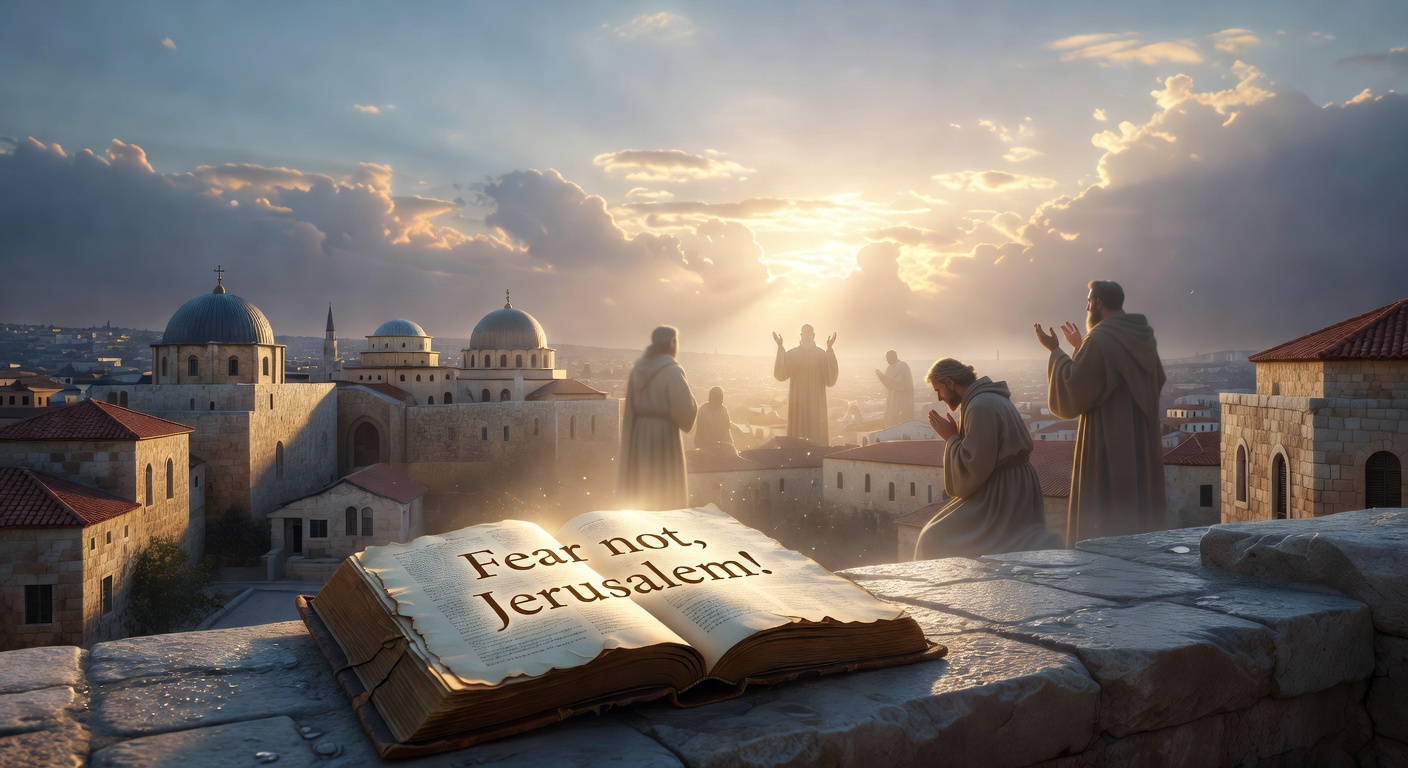
🌟 Fear Not, Jerusalem! 🌟
Dear friends in faith, today we delve into Bible verse #91 from our #FearNot220 series: "Fear not, Jerusalem!" (Baruch 4:30). This powerful exhortation comes from the Book of Baruch, a prophetic text in the Catholic tradition, written during a time of exile and uncertainty for God's people. Jerusalem, symbolizing the holy city and the community of believers, is called to cast aside fear because divine restoration is on the horizon. In the midst of trials—be it personal struggles, societal upheavals, or spiritual doubts—this verse reminds us that God is ever-present, turning sorrow into joy.
Imagine the ancient Israelites, scattered and disheartened, hearing these words as a beacon of hope. Baruch, secretary to the prophet Jeremiah, pens this message to encourage the exiles in Babylon. It's not just about a physical city; it's about the spiritual Jerusalem within each of us—the place where God dwells in our hearts. When life feels like an exile, when fears of failure, loss, or the unknown grip us, God whispers, "Fear not!" He promises renewal, just as He did for Jerusalem: "Take courage, O Jerusalem... for he who brought these calamities upon you will deliver you from the hand of your enemies" (Baruch 4:30, contextually linked).
This call to fearlessness resonates deeply in our modern world. Perhaps you're facing financial worries, health challenges, or relational strains. Or maybe it's the broader fears of global instability, environmental crises, or cultural shifts that unsettle your spirit. Remember, Jerusalem's story is one of resilience. God doesn't abandon His people; He redeems them. As we meditate on this, let's draw wisdom from the Early Church Fathers, who interpreted such verses with profound insight.
St. Jerome, the great biblical scholar of the 4th century, emphasized in his commentaries that Jerusalem represents the Church universal—the bride of Christ. He saw in Baruch's words a foreshadowing of the New Jerusalem in Revelation, where fear has no place because God's light banishes all darkness. Jerome balanced scholarly rigor with pastoral care, urging believers to study Scripture not just intellectually but devotionally, allowing verses like this to fortify the soul against despair.
Complementing this, St. Augustine of Hippo, in his 'City of God,' contrasted the earthly city (prone to fears and conflicts) with the heavenly city of peace. He interpreted calls like "Fear not, Jerusalem!" as invitations to align our lives with divine eternity, where temporal fears dissolve. Augustine's balanced view—acknowledging human frailty while extolling God's grace—encourages us to confess our anxieties and surrender them to Christ, who conquered fear on the cross.
And let's not overlook St. John Chrysostom, the 'golden-mouthed' preacher of Antioch. In his homilies, he often addressed fear in the face of persecution, drawing from Old Testament prophecies. Chrysostom balanced exhortation with empathy, reminding his flock that God's "Fear not" is not a dismissal of suffering but a promise of companionship through it. He urged practical faith: pray fervently, support one another in community, and live virtuously, turning fear into faithful action.
These Fathers provide a balanced tapestry—Jerome's exegetical depth, Augustine's philosophical breadth, and Chrysostom's pastoral warmth—showing us how to internalize this verse. Together, they teach that fearing not means trusting in God's sovereignty, building spiritual resilience, and fostering communal hope.
So, beloved, fear not! Whatever 'exile' you're in, God is orchestrating your deliverance. Lean on His promises, draw from the wisdom of the saints, and step forward in courage. Let this verse be your anchor today. Share your thoughts below—how has "Fear not" spoken to you?
#FearNot220 #091of220 #Catholic