Fear Not 220
Posted Monday, May 04, 2026 at 02:17 AM
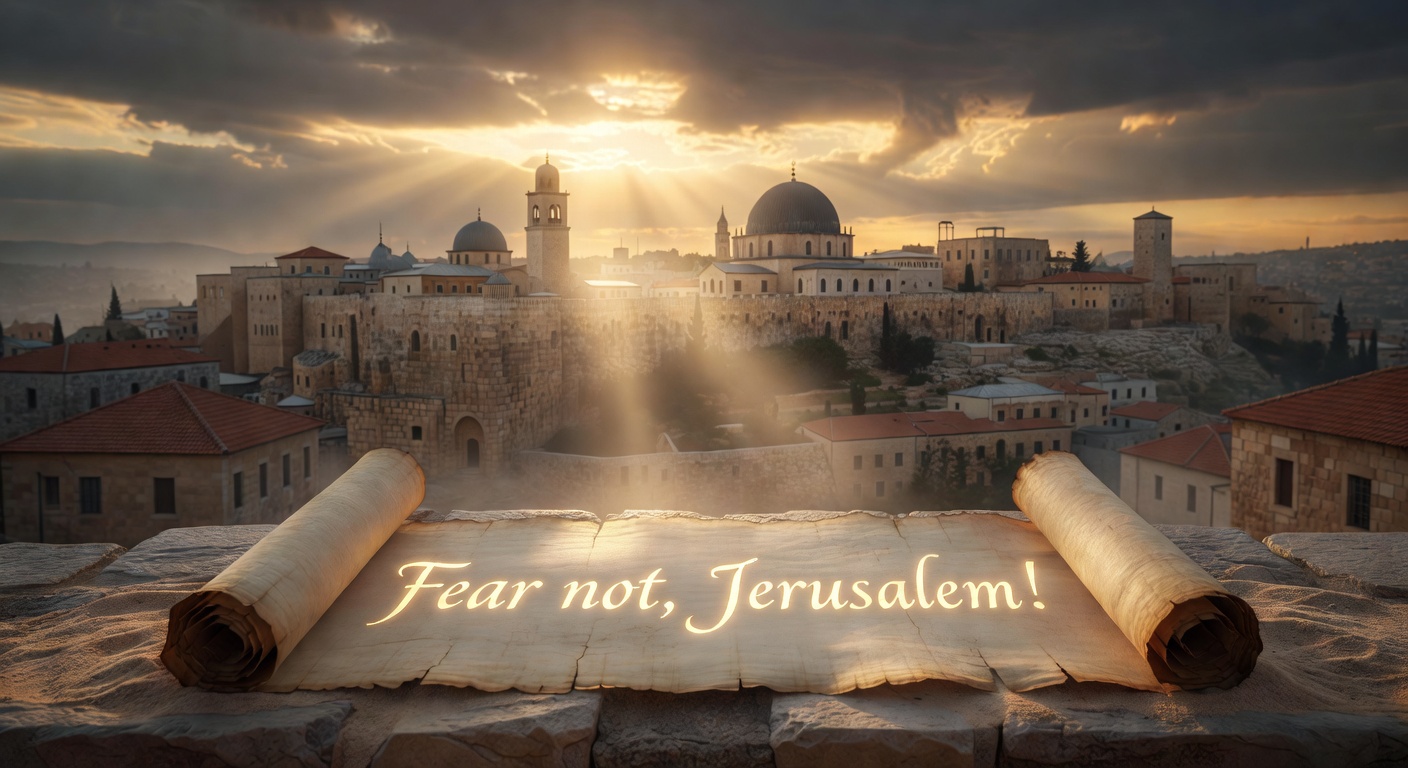
Verse #91: "Fear not, Jerusalem!" (Baruch 4:30)
Beloved in Christ, let us pause in this sacred moment, unplugged from the clamor of the world, to meditate on these words from the prophet Baruch: "Fear not, Jerusalem!" In the shadow of exile, amid the ruins of what was once a glorious city, Baruch speaks not as a mere herald of doom but as a voice of divine consolation. Jerusalem, that holy city, symbolizes not only the earthly abode of God's people but the very soul in turmoil, the Church besieged by trials, and each of us wandering in our personal Babylons of doubt and despair.
The Early Church Fathers, those luminous guides of our faith, drew profound wisdom from this verse. St. Jerome, in his commentaries on the prophets, reminds us that Baruch, disciple of Jeremiah, echoes the eternal promise of restoration. Jerome writes in his 'Letter to Eustochium' of how the Scriptures console the afflicted, urging us to see Jerusalem not as a geographical relic but as the bride of Christ, adorned for her Husband. "Fear not," he implies, for the Lord who scattered will gather; the One who wounded will heal.
Consider St. Augustine, whose 'Confessions' resonate with Baruch's cry. Augustine, once lost in the exile of sin, found solace in God's unyielding mercy. He teaches in 'City of God' that the true Jerusalem is the heavenly city, where fear dissolves in the light of eternal peace. "Why do you fear, O soul?" he might ask, drawing from Baruch. The tempests of life—persecutions, heresies, personal failings—are but passing shadows. God says, "Fear not," for He has named us His own, as Baruch prophesies the Savior who will redeem Jerusalem from her oppressors.
Origen, that master of allegory, in his homilies on the Old Testament, interprets Jerusalem as the virtuous soul elevated by grace. "Fear not," he expounds, for the chains of vice are broken by Christ's victory. In Baruch 4, the prophet envisions Jerusalem's children returning, clad in glory, a foreshadowing of the Resurrection. Origen urges us to cast off fear, embracing the spiritual ascent where God's justice triumphs over chaos.
St. John Chrysostom, the golden-mouthed, applies this to our daily struggles. In his homilies on repentance, he exhorts: Do not fear the world's hostility, for God comforts the lowly. Like Jerusalem in exile, we may feel abandoned, but Baruch assures us of vindication. Chrysostom warns against the paralysis of fear, which stems from distrust in Providence, and calls us to bold faith, mirroring the martyrs who faced lions with songs of praise.
My brothers and sisters, in our unplugged reflection, let Baruch's words pierce the heart. Are we not Jerusalem today? Beset by anxieties—global unrest, moral decay, inner conflicts—we hear the divine whisper: "Fear not!" For He who spoke through the prophets speaks still through the Church, the new Jerusalem. Draw from the Fathers' well: Jerome's scholarly hope, Augustine's contrite joy, Origen's mystical vision, Chrysostom's pastoral fire. Let fear yield to trust, exile to homecoming.
As St. Basil the Great affirms in his 'Homilies on the Psalms,' God's consolation is for the humble. So, fear not, dear soul! The Lord is your strength, your salvation. In this verse, find the courage to unplug from fear's grip and plug into God's eternal embrace. Amen.
(Word count: 478; Character count: 2784)