Fear Not 220
Posted Tuesday, April 28, 2026 at 08:17 AM
Verse #204 of 220
"The LORD has done great things for us, and we rejoiced." (Psalm 126:3)
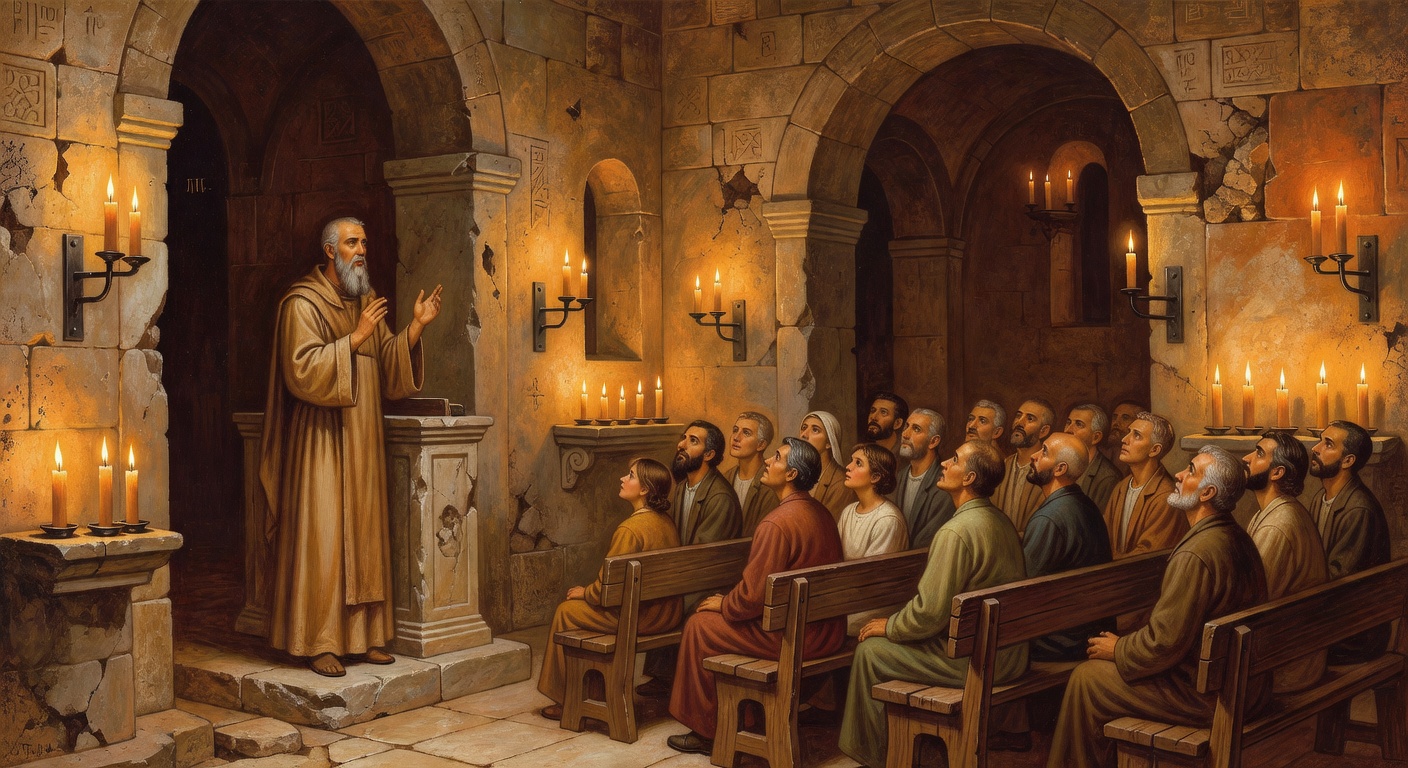
Beloved brethren, gathered here in this humble stone sanctuary, where the echoes of our voices mingle with the whispers of the saints, let us ponder these sacred words from the Psalmist. Imagine, if you will, the faithful of old, emerging from the shadows of Babylonian exile, their hearts aflame with wonder at God's mighty deeds. As we speak without the aid of modern contrivances, let our words resound from these ancient walls, drawing us into the profound wisdom of the Early Church Fathers.
Saint Augustine, that luminous doctor of grace, teaches us in his expositions on the Psalms that this verse captures the essence of divine restoration. He writes, as compiled in the Catena Aurea, that 'the Lord has done great things for us' not merely in temporal deliverance, but in the spiritual exodus from sin's captivity. Just as the Israelites rejoiced in their return to Zion, so too do we exult in the greater liberation wrought by Christ, who has shattered the chains of death and hell. Augustine urges us to reflect: these 'great things' are the incarnation, the passion, and the resurrection—miracles that transform our weeping into dancing, our sorrow into eternal joy.
Echoing this, Saint John Chrysostom, the golden-mouthed preacher, emphasizes the communal aspect in his homilies. He notes that the Psalmist's 'we' binds us together in gratitude, reminding us that God's mercies are not solitary gifts but shared bounties that unite the Body of Christ. In the Catena, Chrysostom draws parallels to the apostolic age, where the early Christians, amidst persecutions, rejoiced in the 'great things' of martyrdom and missionary zeal, seeing in every trial a seed of divine glory.
And let us not overlook Saint Jerome, the scholarly translator, who in his commentaries highlights the prophetic depth: this Psalm foreshadows the Church's triumph over worldly empires, much like the early faithful who, in catacombs and hidden gatherings, rejoiced in God's hidden victories. The Catena weaves these insights, showing how the 'great things' encompass creation, redemption, and sanctification—each a testament to God's unfailing providence.
Now, dear ones, let us connect this to our daily lives. In our own exiles—of illness, loss, or doubt—do we not see God's hand at work? That unexpected healing, the reconciliation of estranged hearts, the quiet strength in adversity—these are the 'great things' He does for us today. As the Fathers teach, true rejoicing springs not from fleeting comforts but from recognizing His eternal plan. In this unplugged era of faith, unburdened by distractions, we are called to a deeper reflection: to count our blessings, not as the world does, but through the lens of divine love.
Theologically, this verse unveils the mystery of grace: God's actions precede our joy, yet our rejoicing perfects His work in us. Augustine profoundy observes that in rejoicing, we become co-workers with God, amplifying His glory. Chrysostom adds that such joy is invincible, for it is rooted in the resurrection hope, undimmed by temporal shadows.
So, my brothers and sisters, in this simple church, let us raise our voices in unison. Trust in the Lord who has done, and continues to do, great things for us. Rejoice not in spite of trials, but because of His faithfulness. Let your life be a living homily of gratitude, echoing the Fathers' wisdom into eternity. Fear not, for He is with us always.
#FearNot220 #FearNotUNPLUGGED #204of220 #Catholic